
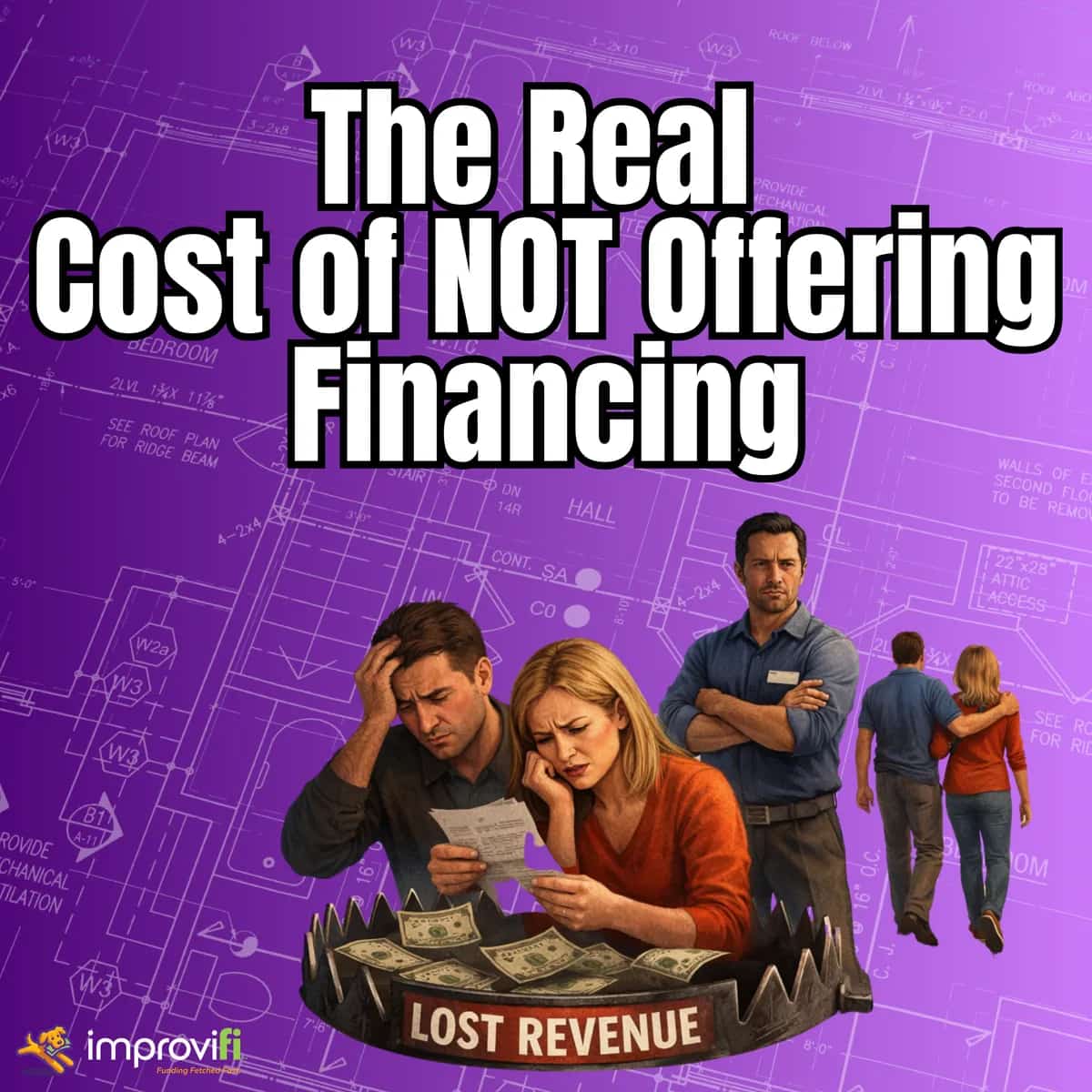
Calculate Lost Revenue, Smaller Project Sizes, and Missed Opportunities When You Operate Cash-Only
Download The Guide Download The Sales ScriptThe Invisible Cost Killing Your Growth
Let me tell you about two contractors in the same market.
Contractor A – “Cash Only Chuck”: (aka: Chucky in the Trucky)
- 15 years in business
- Great reputation, quality work
- Average project: $11,500
- Close rate: 28%
- Annual revenue: $385,000
Contractor B – “Financing-Enabled Frank”:
- 12 years in business
- Similar reputation, similar quality
- Average project: $18,200
- Close rate: 47%
- Annual revenue: $680,000
Same market. Similar skills. One massive difference: Frank offers financing.
The result? Frank makes $295,000 more per year. That’s not a typo. That’s 76% more revenue from the same number of leads, doing the same type of work, in the same geographic area.
Here’s the brutal truth: If you’re not offering financing, you’re not just missing out on a few deals. You’re systematically, consistently leaving hundreds of thousands of dollars on the table every single year.
This guide will open your eyes to exactly what not offering financing is costing you in dollars, in customers, in growth, and in competitive positioning. More importantly, it’ll show you the exact calculations so you can see your own lost revenue.
Warning: These numbers might make you sick. But they should also motivate you to act.
Let’s calculate what cash-only is really costing your business.
Part 1: The Seven Hidden Costs of Cash-Only Operations
Cost #1: The “Think About It” Tax
The scenario we’ve all experienced:
You spend 2 hours on an estimate. Perfect design. Enthusiastic customer. You present the price: $32,000.
The energy shifts.
“We need to think about it.”
Translation: “We don’t have $32,000 sitting around.”
What happens next in cash-only operations:
- 60% never call back
- 25% call a financing-enabled competitor
- 10% do a scaled-down version 2 years later
- 5% eventually come back and sign
You just lost 95% of that sale.
The math:
- Time invested: 2 hours (estimate prep, travel, presentation)
- Your hourly value: $75-150/hour
- Cost of the estimate: $150-300
- Probability of closing: 5%
- Expected value: Almost nothing
If you offered financing:
- Same estimate, same customer
- You say: “That’s $32,000, or about $355/month for 10 years”
- Customer: “Oh, we can afford $355/month!”
- Probability of closing: 60-70%
The “Think About It” Tax calculation:
For every 10 estimates over $15,000:
- Cash-only: Close 1-2 deals = $15,000-30,000 revenue
- With financing: Close 6-7 deals = $90,000-105,000 revenue
Lost revenue per 10 estimates: $60,000-75,000
If you do 100 estimates per year over $15K, you’re losing $600,000-750,000 annually.
Cost #2: The Project Downsizing Penalty
The scenario:
Customer wants a full kitchen remodel: $35,000.
They have $12,000 saved.
Cash-only contractor response: “Well, we could do a scaled-down version for $12,000. We’d do the cabinets but skip the countertops and backsplash for now.”
The customer agrees. You do the $12,000 project.
The reality:
- Customer wanted $35,000 kitchen
- You delivered $12,000 kitchen
- Customer is disappointed
- You made $2,400 profit (20% margin)
Financing-enabled contractor response: “That $35,000 breaks down to about $390/month for 10 years. Does that work better for your budget than depleting your $12,000 in savings?”
The customer chooses financing. You do the $35,000 project.
The reality:
- Customer got what they actually wanted
- You delivered $35,000 kitchen
- Customer is thrilled
- You made $7,000 profit (20% margin)
The Project Downsizing Penalty: $4,600 lost profit on ONE project.
The annual impact:
If you do 30 projects per year that get downsized:
- Average downsize: From $28,000 to $14,000
- Lost revenue per project: $14,000
- Lost profit per project (20% margin): $2,800
Annual lost profit from downsizing: $84,000
That’s $84,000 that walked away because you couldn’t offer payment options.
Cost #3: The Competitive Disadvantage Penalty
The scenario:
Customer gets three estimates:
- You (cash-only): $28,000, excellent proposal
- Competitor A (cash-only): $26,500, decent proposal
- Competitor B (financing-enabled): $29,500, good proposal
What happens:
Your proposal is best. Your price is competitive. You should win.
But Competitor B says: “That’s $328/month for 10 years, and we can get you approved today.”
Customer’s thought process:
- “I don’t have $28,000 cash”
- “But I can afford $328/month”
- “Competitor B’s price is a bit higher, but they make it possible”
Competitor B wins.
You lost because you couldn’t offer what they could.
The Competitive Disadvantage Penalty:
Industry data shows:
- 35% of customers choose financing-enabled contractors over cheaper cash-only competitors
- Average deal lost to financing competitors: $22,000
- Average number of deals lost this way per year: 15-25
Conservative estimate:
- 15 deals × $22,000 = $330,000 in revenue
- At 20% margin = $66,000 in profit
You’re losing $66,000 annually to competitors simply because they offer financing and you don’t.
Cost #4: The Lead Generation Cost Multiplier
The scenario:
You spend money generating leads:
- Google Ads: $800/month
- Facebook Ads: $400/month
- Direct mail: $600/month
- Home shows: $300/month
- Total: $2,100/month = $25,200/year
Your lead-to-close rate (cash-only): 28%
That $25,200 investment generates approximately:
- 200 leads/year
- 56 closed projects
- Cost per acquisition: $450
If you offered financing:
Same $25,200 investment, but close rate increases to 47%:
- 200 leads/year (same)
- 94 closed projects (68% more!)
- Cost per acquisition: $268
The impact:
- 38 more closed projects per year from the same marketing spend
- Same marketing dollars, 68% more customers
Or looked at another way:
To get 94 customers cash-only, you’d need to spend:
- 94 customers × $450 per acquisition = $42,300
By offering financing, you saved $17,100 in marketing costs to get the same number of customers.
The Lead Generation Cost Multiplier: $17,100 wasted annually on inefficient lead conversion.
Cost #5: The Small Project Trap
The scenario:
Because you’re cash-only, you start accepting smaller projects to maintain cash flow:
- $3,500 bathroom refresh instead of $18,000 full remodel
- $5,000 deck repair instead of $22,000 complete rebuild
- $2,800 partial roof repair instead of $14,000 full replacement
The problem with small projects:
- Same overhead costs (estimate time, travel, scheduling)
- Similar stress and coordination
- Much lower profit per job
- More jobs needed to hit revenue goals = more complexity
The math:
Scenario A (Cash-only, small projects):
- Average project: $4,500
- Profit margin: 18% (lower due to inefficiency)
- Profit per project: $810
- Projects needed for $250K revenue: 56 projects
- Projects you can physically complete: 60/year maximum
Scenario B (Financing-enabled, right-sized projects):
- Average project: $16,500
- Profit margin: 22% (better efficiency)
- Profit per project: $3,630
- Projects needed for $250K revenue: 15 projects
- Projects you can physically complete: 40/year maximum
- Potential revenue at 40 projects: $660,000
The Small Project Trap:
- Cash-only forces you into lower-margin, higher-volume work
- You’re working harder for less profit
- You’re artificially capping your revenue potential
Annual cost: Operating at 38% of your revenue potential ($250K vs $660K)
Book A DemoCost #6: The Referral Value Gap
The scenario:
Customer A (got scaled-down project):
- Wanted $30,000 kitchen
- Could only afford $12,000 version
- Mildly satisfied with compromise
- Tells friends: “They did okay, but I wish I could have done more”
Referral value: Low. Maybe 1 referral in 3 years.
Customer B (financed dream project):
- Wanted $30,000 kitchen
- Financed it at $334/month
- Thrilled with complete transformation
- Tells everyone: “They made it possible! Look at my beautiful kitchen!”
Referral value: High. 3-5 referrals within 2 years.
The Referral Value Gap:
Satisfied customers (full projects) generate 4x more referrals than compromise customers (scaled-down projects).
The math:
- 30 projects per year
- Cash-only: 30% get full vision = 9 satisfied customers generating 2 referrals each = 18 referrals
- Financing-enabled: 85% get full vision = 25.5 satisfied customers generating 4 referrals each = 102 referrals
That’s 84 more qualified referrals per year.
At 40% close rate and $20,000 average:
- 34 additional projects from referrals
- $680,000 in additional revenue
- $136,000 in additional profit (20% margin)
The Referral Value Gap: $136,000 in lost referral-driven profit annually.
Cost #7: The Business Valuation Discount
The scenario (most contractors don’t think about this):
When you eventually sell your business, buyers evaluate:
- Revenue consistency and growth
- Customer acquisition cost
- Competitive positioning
- Market adaptability
Cash-only businesses are worth less.
Here’s why:
Business A (cash-only):
- Revenue: $500,000
- Growth rate: 3% annually (stagnant)
- Customer acquisition: High cost, low close rate
- Market position: Vulnerable to financing-enabled competitors
- Business multiple: 1.5x revenue
- Valuation: $750,000
Business B (financing-enabled):
- Revenue: $850,000
- Growth rate: 15% annually (strong)
- Customer acquisition: Efficient, high close rate
- Market position: Competitive advantage
- Business multiple: 2.5x revenue
- Valuation: $2,125,000
The Business Valuation Discount: $1,375,000 less when you sell.
Even if you’re years from selling, that valuation gap exists TODAY. Your business is worth less right now because it’s cash-only.
Part 2: Calculating YOUR Lost Revenue
The Lost Revenue Calculator
Let’s get specific to YOUR business. Grab a calculator and your numbers from last year.
Step 1: Annual Estimate Data
How many estimates did you provide last year? ___________
What was your close rate? ___________%
How many customers said “we need to think about it”? ___________
Step 2: Project Downsizing Analysis
How many projects were scaled down from original vision? ___________
Average original project value: $___________
Average actual completed value: $___________
Average difference: $___________
Step 3: Your Lost Revenue Calculation
Lost Revenue Source #1: “Think About It” Deals
Number of “think about it” responses: _________ (A)
Average project value: $_________ (B)
Estimated close rate if financing offered (use 60%): 0.60 (C)
Lost revenue = A × B × C
Example:
- 40 “think about it” × $25,000 × 0.60 = $600,000 lost
Your lost revenue from “think about it”: $_________________
Lost Revenue Source #2: Project Downsizing
Projects downsized: _________ (D)
Average downsize amount: $_________ (E)
Lost revenue = D × E
Example:
- 25 projects × $12,000 average downsize = $300,000 lost
Your lost revenue from downsizing: $_________________
Lost Revenue Source #3: Competitive Losses
Estimates lost to financing-enabled competitors: _________ (F)
Average value of lost estimate: $_________ (G)
Lost revenue = F × G
Example:
- 18 lost deals × $22,000 = $396,000 lost
Your lost revenue from competitive disadvantage: $_________________
Lost Revenue Source #4: Referral Gap
Current annual projects: _________ (H)
Estimated referrals you’d gain with financing (use 1.5 per satisfied customer): _________ (I)
Average referral project value: $_________ (J)
Referral close rate (use 40%): 0.40 (K)
Lost revenue = H × I × J × K
Example:
- 35 projects × 1.5 referrals × $20,000 × 0.40 = $420,000 lost
Your lost revenue from referral gap: $_________________
YOUR TOTAL ANNUAL LOST REVENUE:
|
Lost Revenue Source |
Your Amount |
|
“Think About It” Deals |
$__________ |
|
Project Downsizing |
$__________ |
|
Competitive Losses |
$__________ |
|
Referral Gap |
$__________ |
|
TOTAL LOST REVENUE |
$__________ |
At 20% profit margin, your lost profit is: $_________________
HERE IS YOUR SIMPLE COST CALCULATOR
file:///Users/christopherscoville/Downloads/improvifi-lost-revenue-calculator.html
Part 3: The Compound Effect Over Time
What Cash-Only Costs You Over 5 Years
Let’s say your annual lost revenue is $500,000 (conservative for most contractors).
Year 1: $500,000 lost Year 2: $500,000 lost (plus you’re further behind competitors) Year 3: $500,000 lost (plus your reputation suffers from scaled-down projects) Year 4: $500,000 lost (plus financing-enabled competitors dominate your market) Year 5: $500,000 lost (plus you’ve missed entire growth trajectory)
5-Year total: $2,500,000 in lost revenue
At 20% margins: $500,000 in lost profit
But it’s actually worse because of compounding effects:
The Compound Effect:
- Lost referrals would have generated more referrals
- Smaller projects hurt your reputation and reduce premium project opportunities
- Competitors grow stronger while you stagnate
- Your team can’t grow because revenue doesn’t support it
Realistic 5-year cost with compounding: $3,500,000 – $5,000,000 in lost revenue
That’s not theoretical. That’s real money you’ll never see because you didn’t offer financing.
Part 4: Real Contractor Case Studies – Before and After Financing
Case Study 1: Mike’s Roofing – Seattle, WA
Before Financing (Cash-Only Operations):
- Annual revenue: $520,000
- Average project: $12,800
- Close rate: 31%
- Projects per year: 41
- “Think about it” rate: 58%
- Scaled-down projects: 18 per year
After Adding Financing:
- Annual revenue: $890,000 (71% increase)
- Average project: $19,200 (50% increase)
- Close rate: 52% (68% improvement)
- Projects per year: 46
- “Think about it” rate: 22%
- Scaled-down projects: 4 per year
What Mike calculated he was losing (pre-financing):
- Lost revenue from “think about it”: $380,000/year
- Lost revenue from downsizing: $115,000/year
- Lost revenue from competitive losses: $165,000/year
- Total annual lost: $660,000
Mike’s reflection: “I was proud of my $520K revenue. I thought I was doing well. Then I calculated what I was leaving on the table and nearly fell over. I was operating at 44% of my actual potential. Adding financing was the single best business decision I’ve made in 18 years.”
Case Study 2: Premier Kitchen & Bath – Austin, TX
Before Financing:
- Annual revenue: $1,240,000
- Average project: $31,500
- Close rate: 28%
- Estimates per year: 141
- Closed projects: 39
After Adding Financing:
- Annual revenue: $2,130,000 (72% increase)
- Average project: $43,800 (39% increase)
- Close rate: 49% (75% improvement)
- Estimates per year: 142 (same marketing spend)
- Closed projects: 70
Sarah’s (owner) calculation of lost revenue:
- Lost from “think about it”: $1,125,000/year
- Lost from downsizing: $285,000/year
- Lost from competitive positioning: $430,000/year
- Lost from referral gap: $520,000/year
- Total annual lost: $2,360,000
Sarah’s reflection: “We were already successful, doing over a million in revenue. But we were leaving $2.3 million on the table. That’s insane. When I saw those numbers, I knew we had to change immediately. Adding financing literally doubled our business in 18 months.”
Case Study 3: All-Pro Siding & Windows – Denver, CO
Before Financing:
- Annual revenue: $680,000
- Average project: $9,200
- Close rate: 25%
- Projects per year: 74
- Profit margin: 18% (low due to small project inefficiency)
After Adding Financing:
- Annual revenue: $1,140,000 (68% increase)
- Average project: $15,800 (72% increase)
- Close rate: 44% (76% improvement)
- Projects per year: 72 (fewer projects, higher value!)
- Profit margin: 23% (better efficiency on larger projects)
Jason’s calculation:
- Lost from “think about it”: $410,000/year
- Lost from downsizing: $195,000/year
- Lost from small project trap: Operating at 60% of potential revenue
- Total annual lost: $605,000
Jason’s reflection: “The crazy thing is we’re actually doing fewer projects now but making way more money. We were killing ourselves doing 74 small projects. Now we do 72 right-sized projects at better margins. We work less and profit more. That’s what financing did for us.”
Part 5: The Opportunity Cost Analysis
What Could You Do With That Lost Money?
Let’s say you’re losing $400,000 in revenue annually (conservative for most contractors).
At 20% margins, that’s $80,000 in lost profit per year.
What could $80,000 annually do for your business?
Option A: Hire Another Crew
- Salary for skilled team member: $55,000
- Additional capacity: 15-20 more projects per year
- Additional revenue: $300,000+
- That lost $80,000 could have funded expansion
Option B: Invest in Marketing
- $80,000 in strategic marketing
- Generate 150-200 additional quality leads
- Close 60-80 more projects
- Grow business by 40-50%
Option C: Buy Equipment
- New truck: $45,000
- Trailer and tools: $25,000
- Technology/software: $10,000
- Professional branding: Remaining
- Build a more professional operation
Option D: Personal Wealth Building
- Max out retirement accounts: $66,000
- Emergency fund: $14,000
- Financial security for your family
Option E: Business Acquisition
- $80,000 per year for 5 years = $400,000
- Enough to acquire a competitor
- Double your market share
- Dominate your area
The opportunity cost of NOT offering financing isn’t just the lost revenue—it’s everything that revenue could have become.
Part 6: The Competitive Market Reality
What’s Happening While You Stay Cash-Only
Market Trend Data (2020-2025):
- Percentage of contractors offering financing: 2020: 32% → 2025: 67%
- Financing-enabled contractors growing at: 15-25% annually
- Cash-only contractors growing at: 2-5% annually
- Customer expectation of financing availability: 2020: 48% → 2025: 78%
Translation: Financing is becoming table stakes, not a differentiator.
The Market Reality:
5 years ago: Offering financing = competitive advantage Today: Offering financing = expected by customers Tomorrow: NOT offering financing = deal-breaker for most customers
What your competitors are doing:
Scenario 1: Local Competitor A
- Added financing 2 years ago
- Revenue growth: 45% in first year, 28% in second year
- Now dominating mid-to-large project market
- Taking market share from cash-only contractors (you)
Scenario 2: National Franchise Enters Market
- Backed by corporate financing programs
- Aggressive marketing: “Easy monthly payments!”
- Taking customers who never even call cash-only contractors
- Changing customer expectations in your market
Scenario 3: The Amazon Effect
- Customers expect seamless, modern payment options
- “Buy now, pay later” is normalized across retail
- Home improvement is following the same path
- Cash-only feels outdated and restrictive
The brutal truth: Every month you don’t offer financing, your competitive position weakens.
Part 7: The Psychology of “I Can Afford That”
Understanding the Mental Difference
Psychological Principle: Payment Framing
Human brains process “$28,000” and “$311/month” completely differently.
The $28,000 Frame:
- Triggers financial anxiety
- Compared against bank account balance
- Feels like sacrifice and depletion
- Results in: “I can’t afford that”
The $311/Month Frame:
- Compared against monthly budget
- Feels like subscription (Netflix, gym, car payment)
- Fits into existing mental expense categories
- Results in: “I can afford that”
They’re the same amount. But the framing completely changes the decision.
The Research:
Studies on consumer purchasing behavior show:
- 73% of consumers prefer monthly payments over lump sums for purchases over $5,000
- Customers approve projects 2.3x more often when presented as monthly payments
- Average project size increases 40-60% when monthly framing is used
What cash-only contractors miss:
By only presenting total costs, you’re triggering the wrong psychological response. You’re making customers compare against their bank account instead of their monthly budget.
Result: Smaller projects, more objections, lower close rates, lost revenue.
Book A DemoPart 8: The “But My Customers Pay Cash” Myth
Debunking the Most Common Objection
The myth: “My customers always pay cash. They don’t need financing.”
The reality: Your customers pay cash because that’s the only option you give them.
The data:
When financing-enabled contractors track payment methods:
- 60-65% of customers CHOOSE financing when offered
- This includes customers who COULD pay cash
- Only 35-40% actually pay cash when both options are available
Why do customers with cash choose financing?
Reason #1: Opportunity Cost “I could pay $30,000 cash, but I’d rather keep that in my investments earning 10% and finance at 8%”
Reason #2: Emergency Reserves “I have the cash, but I don’t want to deplete my emergency fund. What if the car breaks down or I lose my job?”
Reason #3: Cash Flow Management “I’d rather pay $350/month and keep my cash available for other opportunities and expenses”
Reason #4: Credit Building “This loan will improve my credit mix and show consistent payment history”
Case Study: The Unexpected Financing Customer
Customer profile:
- Retired physician
- Net worth: $3.5 million
- Clearly has cash available
- Estimate: $45,000 kitchen
Contractor’s assumption: “He’ll definitely pay cash”
What happened:
- Contractor offered financing option anyway
- Customer chose financing at 6.99%
- His response: “Why would I pull $45,000 from investments earning 12% to pay cash? The math doesn’t make sense.”
Lesson: You can’t predict who wants financing. Always offer both options.
Part 9: The Time Value of Money You’re Missing
What Delayed Projects Cost You
The scenario:
Customer wants $25,000 bathroom remodel.
Cash-only: “We don’t have that saved yet. Let’s wait 18 months to save up.”
Result:
- You lose the sale today
- You MIGHT get it in 18 months (if they don’t forget, move, or hire someone else)
- Present value of future $25,000 project: $22,500 (assuming 5% discount rate)
- You’re effectively discounting your work by 10% by waiting
Financing-enabled: “That’s $278/month for 10 years. Want to start next month?”
Result:
- You close the sale today
- You get paid $25,000 within 2 weeks
- No waiting, no risk of losing the project
- Present value: Full $25,000
The Time Value of Money principle:
$25,000 today is worth more than $25,000 in 18 months because:
- You can reinvest that money in business growth
- Inflation erodes future purchasing power
- There’s risk they never move forward
- Your opportunity cost is high
The calculation for YOUR business:
How many projects are you waiting on for customers to “save up”? ___________
Average project value: $___________
Average wait time: _________ months
Your delayed project revenue: $_________________
Present value discount (use 5% annually):
If 15 projects averaging $20,000 are delayed an average of 12 months:
- Nominal future revenue: $300,000
- Present value: $285,000
- Lost value: $15,000
Plus the risk they never happen: Apply 40% failure rate
- Actual expected value: $171,000
- Additional lost value: $114,000
Total cost of delayed projects: $129,000 annually
Part 10: The Math That Should Scare You
Breaking Down the Total Cost
Let’s consolidate everything we’ve covered and show the complete picture.
ANNUAL LOST REVENUE BREAKDOWN (Conservative Estimates for $500K Revenue Contractor):
|
Cost Category |
Annual Loss |
|
“Think About It” Deals |
$250,000 |
|
Project Downsizing |
$85,000 |
|
Competitive Disadvantage |
$120,000 |
|
Lead Generation Inefficiency |
$18,000 |
|
Small Project Trap Opportunity Cost |
$140,000 |
|
Referral Value Gap |
$95,000 |
|
Delayed/Lost Projects |
$75,000 |
|
TOTAL ANNUAL LOST REVENUE |
$783,000 |
At 20% profit margin: $156,600 in lost profit annually
Over 10 years: $1,566,000 in lost profit
That’s $1.5 million you’ll never see because you didn’t offer financing.
But wait, there’s more (the compounding effect):
If you invested that $156,600 annually at 7% return:
- Year 10 value: $2,157,000
- Year 20 value: $6,408,000
- Year 30 value: $14,769,000
Not offering financing doesn’t just cost you today’s revenue—it costs you generational wealth.
Part 11: What About the Fees?
“But I’ll Have to Pay Lender Fees!”
The objection we hear:
“If I offer financing, I’ll pay fees to lenders. That cuts into my profit. I’m better off cash-only.”
The reality check:
Let’s do the math on whether fees matter.
Scenario A: Cash-Only (No Fees, Fewer Sales)
- Projects per year: 30
- Average project: $15,000
- Revenue: $450,000
- Profit margin: 20%
- Annual profit: $90,000
- Lender fees paid: $0
Scenario B: Financing-Enabled (Fees on 50% of Projects)
- Projects per year: 48 (60% more)
- Average project: $22,000 (47% higher)
- Revenue: $1,056,000
- Lender fees (3% on 50% of revenue): $15,840
- Net revenue after fees: $1,040,160
- Profit margin: 20%
- Annual profit: $208,032
- Less lender fees: $208,032 – $15,840 = $192,192
The comparison:
- Cash-only profit: $90,000
- Financing-enabled profit: $192,192
- Difference: $102,192 MORE profit even after paying fees
The fees cost you $15,840, but you made an extra $118,032 in profit.
ROI on lender fees: 745%
The bottom line: Worrying about lender fees while ignoring lost revenue is like worrying about the cost of gas while your car sits in the garage.
Part 12: The “I’m Too Busy for This” Fallacy
Time Investment vs. Revenue Return
The objection:
“Adding financing sounds complicated. I don’t have time to learn new systems. I’m already too busy.”
The reality:
Time investment to add financing:
- Week 1: 5 hours (application and document gathering)
- Week 2: 3 hours (onboarding and training)
- Week 3: 4 hours (team training and practice)
- Week 4: 2 hours (first deals and troubleshooting)
- Total: 14 hours
Time savings from financing:
- Less time chasing payments: 3 hours/week saved
- Fewer estimate callbacks: 2 hours/week saved
- Less re-estimating scaled-down projects: 2 hours/week saved
- Total: 7 hours/week saved = 364 hours/year saved
The math:
- Investment: 14 hours
- Return: 364 hours saved annually
- ROI: 2,500% in time savings alone
Plus the revenue impact:
- 14 hours invested
- $150,000+ additional annual profit (conservative)
- That’s $10,714 per hour invested
Is 14 hours of your time worth $150,000?
The “too busy” objection translates to: “I’m too busy making $90,000 to spend 14 hours making $240,000.”
Does that make sense?
Part 13: The Breaking Point Question
When Will You Finally Make the Change?
Ask yourself these questions:
Question 1: How many more estimates need to end with “we need to think about it”?
You know the feeling. The excitement drains from the room. The customer loves the design but can’t move forward. It’s happened dozens of times this year already.
How many more times before you do something about it?
Question 2: How many more projects need to get scaled down?
You design the perfect solution. Customer loves it. Then you have to water it down to match their available cash. They settle. You settle. Nobody gets what they really wanted.
How many more compromised projects before you offer a better solution?
Question 3: How many more deals need to go to financing-enabled competitors?
You lose bids to contractors with higher prices and lower quality. Why? Because they make it affordable and you don’t.
How many more losses before you level the playing field?
Question 4: How much longer will you leave money on the table?
Every month that passes, you’re losing $30,000-80,000 in revenue. Every year, $400,000-$1,000,000. Every decade, millions.
How long before you decide that’s too much to leave behind?
Question 5: What’s the real reason you haven’t added financing yet?
Be honest:
- Is it fear of the unknown?
- Is it resistance to change?
- Is it pride (“my customers don’t need that”)?
- Is it just inertia?
Because it’s not lack of opportunity. The opportunity is massive and it’s sitting right in front of you.
Book A DemoPart 14: The Calculation That Changes Everything
Your Personal Lost Revenue Reality Check
Let’s make this personal and specific to YOUR business right now.
WORKSHEET: Your Annual Lost Revenue
Section 1: Basic Business Metrics
- Annual estimates provided: ___________
- Current close rate: %
- Average project value: $
- Annual revenue: $___________
Section 2: “Think About It” Analysis
- Estimates that ended with “think about it”: ___________ (typically 40-60% of estimates)
- Average value of those estimates: $___________
- Estimated close rate if financing offered (use 55%): 0.55
Calculation: Lost revenue from “think about it” = E × F × G
Your number: $_________________
Section 3: Project Downsizing Analysis
- Projects downsized from original vision: ___________ (typically 30-40% of completed projects)
- Average original vision value: $___________
- Average completed value: $___________
- Average downsize amount (I – J): $___________
Calculation: Lost revenue from downsizing = H × K
Your number: $_________________
Section 4: Competitive Loss Analysis
- Estimates where you were competitive but lost to financing-enabled competitor: ___________ (ask your team)
- Average value of lost estimates: $___________
Calculation: Lost revenue from competitive disadvantage = L × M
Your number: $_________________
Section 5: Average Project Value Gap
- Your current average project value: $___________
- Industry average for financing-enabled contractors: $_________ (typically 45-50% higher than cash-only)
- Gap per project (O – N): $___________
- Number of projects you complete annually: ___________
Calculation: Lost revenue from smaller projects = P × Q
Your number: $_________________
Section 6: Lead Efficiency Gap
- Annual marketing/advertising spend: $___________
- Current cost per acquisition (R ÷ number of customers): $___________
- Estimated cost per acquisition with financing (typically 35-40% lower): $___________
- Savings per customer (S – T): $___________
- Number of customers annually: ___________
Calculation: Wasted marketing dollars = U × V
Your number: $_________________
YOUR TOTAL ANNUAL LOST REVENUE:
|
Category |
Your Lost Revenue |
|
“Think About It” Deals |
$_____________ |
|
Project Downsizing |
$_____________ |
|
Competitive Losses |
$_____________ |
|
Average Project Gap |
$_____________ |
|
Marketing Inefficiency |
$_____________ |
|
TOTAL LOST REVENUE |
$_____________ |
At your profit margin (____ %), lost annual profit: $_________________
Lost over 5 years: $_________________
Lost over 10 years: $_________________
Now Answer This:
Can you afford to ignore that number?
Part 15: The ROI of Adding Financing
What You Gain vs. What You Invest
THE INVESTMENT:
Upfront costs:
- Time to apply and onboard: 14 hours ($0 cash cost)
- Training team: 6 hours ($0 cash cost)
- Updating marketing materials: $500-1,500
- Platform fees: $0 (most programs are free to join)
- Total upfront investment: $500-1,500
Ongoing costs:
- Lender fees on promotional financing: 3-6% of financed amount (optional, can be passed to customer or built into pricing)
- Time to process applications: 5 minutes per estimate
- Monthly platform fees: $0-50 depending on program
- Total ongoing costs: Minimal to zero if not using promotional programs
THE RETURN:
Based on industry averages for contractors adding financing:
Year 1:
- Revenue increase: 35-50%
- Average project value increase: 40-47%
- Close rate improvement: 15-20 percentage points
- Additional profit (20% margin): $60,000-150,000
Year 2:
- Revenue increase: 50-75% (cumulative)
- Referral business increases
- Market positioning strengthens
- Additional profit: $100,000-250,000
Year 3-5:
- Revenue stabilizes at 60-90% higher than pre-financing
- Business valuation increases significantly
- Competitive moat strengthened
- Additional profit per year: $120,000-350,000
THE ROI CALCULATION:
Investment: $1,000 upfront + minimal ongoing Year 1 return: $80,000 (conservative) ROI: 8,000%
Compare that to any other business investment:
- New truck: Returns capacity, not revenue
- Marketing campaign: 200-500% ROI if successful
- New hire: 150-300% ROI if productive
- Adding financing: 8,000% ROI
There is no business decision with higher ROI than adding financing.
Period.
Part 16: The Emotional Cost (The One Nobody Talks About)
What Cash-Only Does to Your Soul
Beyond the numbers, there’s an emotional cost to cash-only operations that’s rarely discussed.
The Frustration of “Almost Sales”
You spend hours designing the perfect solution. The customer is excited. You present the price. They deflate. “We need to think about it.”
You drive home knowing:
- They wanted it
- You could deliver it
- Price wasn’t unreasonable
- They just didn’t have the cash available today
That feeling, over and over, wears on you.
The Guilt of Compromised Projects
Customer wanted the dream kitchen. You gave them the budget version. They say they’re happy, but you see the disappointment when they look at what they settled for.
You know you could have delivered their vision if you’d just had financing to offer.
The Resentment Toward Competitors
You watch financing-enabled competitors grow. They’re not better contractors. They might be worse. But they’re winning because they offer payment options.
It eats at you that the playing field isn’t level.
The Stress of Unpredictable Cash Flow
Big project closes: Cash flows. Nothing closes for three weeks: Stress mounts. You’re on a revenue rollercoaster because you depend on customers having cash saved up.
Financing creates predictable, consistent deal flow.
The Imposter Syndrome
Deep down, you wonder: “Am I falling behind? Am I running a modern business or am I stuck in 1995? Why haven’t I adapted yet?”
The emotional cost compounds daily.
Ask yourself: What is peace of mind worth?
What would it feel like to:
- Close 60-70% of estimates instead of 25-30%
- Deliver dream projects instead of compromised versions
- Compete on value, not on who has cash saved
- Have predictable, growing revenue
- Feel like you’re running a modern, professional business
The emotional ROI of adding financing might be even higher than the financial ROI.
Part 17: The “I’ll Do It Later” Trap
Why Waiting Costs More Than You Think
The most dangerous phrase in business: “I’ll add financing eventually.”
The compounding cost of delay:
If you add financing TODAY:
- Month 1-2: Setup and training
- Month 3: First financed sales
- Month 4-12: Revenue ramps up
- Year 1 additional profit: $80,000
If you add financing in 6 MONTHS:
- Months 1-6: Lost revenue continues ($40,000 in lost profit)
- Month 7-8: Setup and training
- Month 9: First financed sales
- Months 10-12: Revenue ramps up
- Year 1 additional profit: $20,000
- Cost of 6-month delay: $60,000
If you add financing in 1 YEAR:
- Year 1: Lost revenue continues ($80,000 in lost profit)
- Year 2: Setup and revenue ramp
- Cost of 1-year delay: $140,000
If you add financing in 2 YEARS:
- 2 years of lost revenue: $160,000+ in lost profit
- Competitors strengthen their market position
- Your reputation as “cash-only” solidifies
- Harder to change customer perceptions
- Cost of 2-year delay: $250,000+
The math is brutal: Every month you wait costs you $6,000-10,000 in profit.
What are you waiting for?
- The “perfect time”? (It doesn’t exist)
- To be “less busy”? (You’ll always be busy)
- To “think about it more”? (You’ve thought about it enough)
- For your competitor to do it first? (They probably already have)
The perfect time to add financing was 5 years ago. The second-best time is TODAY.
Part 18: The Action Plan to Stop the Bleeding
How to Stop Losing Money This Month
You’ve calculated your lost revenue. You’ve seen the opportunity cost.
Now what?
IMMEDIATE ACTIONS (Today – This Week):
Day 1 (TODAY):
- [ ] Go to Improvifi marketplace and start your application (30 minutes)
- [ ] Schedule consultation with Improvifi team (15 minutes)
- [ ] Tell your team: “We’re adding financing” (5 minutes)
Day 2-3:
- [ ] Gather required documents for lender applications (1 hour)
- [ ] Complete marketplace application (1 hour)
- [ ] Identify 3-5 “think about it” prospects from last month to re-contact once approved
Day 4-7:
- [ ] Attend consultation with Improvifi (45 minutes)
- [ ] Submit lender applications (1 hour)
- [ ] Update website to mention “Financing Available” (30 minutes)
- [ ] Plan team training for when approvals come through
WEEKS 2-4: (Full implementation covered in Guide #2)
SHORT-TERM ACTIONS (This Month):
Week 2:
- [ ] Complete lender onboarding
- [ ] Train team on financing conversations
- [ ] Update all marketing materials
Week 3:
- [ ] Launch financing in all estimates
- [ ] Re-contact old “think about it” leads
- [ ] Submit first financing applications
Week 4:
- [ ] Close first financed deal
- [ ] Celebrate with team
- [ ] Refine process based on learnings
RESULT: Within 30 days, you go from losing $40,000-80,000/month to capturing that revenue.
30 days from now, you could have:
- 3-5 closed financed deals
- $60,000-120,000 in revenue that would have been lost
- Momentum building in your business
- Competitive positioning strengthened
Or you could have:
- Same problems
- Same “think about it” responses
- Same scaled-down projects
- Same lost revenue
It’s your choice. Make it today.
Part 19: Real Numbers from Real Contractors
What They Were Losing (And What They Gained)
Contractor #1: James – Kitchen & Bath Specialist
BEFORE (Cash-Only):
- Revenue: $740,000
- Estimates: 95/year
- Close rate: 29%
- “Think about it”: 51 estimates
- Projects downsized: 19
CALCULATED LOST REVENUE:
- “Think about it” (51 × $32,000 × 55%): $898,800
- Downsizing (19 × $14,000): $266,000
- Competitive losses (estimate): $180,000
- TOTAL LOST: $1,344,800 annually
AFTER (Financing-Enabled, Year 1):
- Revenue: $1,290,000 (74% increase)
- Estimates: 98/year (same marketing)
- Close rate: 52%
- “Think about it”: 18 estimates
- Projects downsized: 3
James’s reflection: “I was losing $1.3 million a year. My actual revenue was $740K. That means I was operating at 35% of my potential. The day I saw those numbers, I couldn’t sleep. I applied for financing the next morning. Best decision of my career.”
Contractor #2: Maria – Roofing Company
BEFORE (Cash-Only):
- Revenue: $485,000
- Estimates: 142/year
- Close rate: 24%
- Average project: $14,200
CALCULATED LOST REVENUE:
- “Think about it” (79 × $16,500 × 55%): $717,255
- Competitive losses: $165,000
- Small project trap: Operating at 58% of potential
- TOTAL LOST: $882,255 annually
AFTER (Financing-Enabled, Year 1):
- Revenue: $895,000 (84% increase)
- Estimates: 145/year
- Close rate: 43%
- Average project: $19,800
Maria’s reflection: “I thought roofing was different that people always paid cash for roofs. I was wrong. 67% of my customers chose financing when I started offering it. Revenue almost doubled in 12 months.”
Contractor #3: David & Sons General Contracting
BEFORE (Cash-Only):
- Revenue: $1,120,000
- Established business (22 years)
- Strong reputation
- “Doing fine” mentality
CALCULATED LOST REVENUE:
- “Think about it”: $485,000
- Downsizing: $210,000
- Referral gap: $340,000
- Competitive losses: $275,000
- TOTAL LOST: $1,310,000 annually
AFTER (Financing-Enabled, 18 months in):
- Revenue: $2,180,000 (95% increase)
- Same team size (work smarter, not harder)
- Higher profit margins (larger projects)
- Business valuation increased from $1.6M to $4.8M
David’s reflection: “After 22 years, I thought I knew everything about this business. Then I calculated I was leaving $1.3 million on the table annually. I was stunned. Adding financing didn’t just grow revenue it transformed everything. Our business is worth 3x what it was 18 months ago.”
Part 20: The Final Reality Check
The Question That Matters
After reading this guide, you know:
✓ How much revenue you’re losing annually
✓ Why cash-only puts you at a competitive disadvantage
✓ The compound effect of years of lost opportunity
✓ The minimal investment required to add financing
✓ The massive ROI of making the change
✓ Real examples of contractors who transformed their businesses
There’s only one question left:
Will you do something about it?
Option 1: Do Nothing
Close this guide. Go back to business as usual. Continue operating cash-only.
The result:
- This month: Lose $40,000-80,000 in revenue
- This year: Lose $400,000-$1,000,000 in revenue
- Over 5 years: Lose $2-5 million in revenue
- Over 10 years: Lose $5-15 million in revenue
- When you sell: Business worth 30-50% less
Option 2: Take Action Today
Click the links below. Start your application. Make the commitment.
The result:
- This month: Start capturing lost revenue
- This year: Grow 50-75%
- Over 5 years: Build a dominant market position
- Over 10 years: Create generational wealth
- When you sell: Business worth 2-3x more
The choice is binary. You either capture this revenue or you don’t.
Conclusion: Stop Leaving Money on the Table
Every estimate that ends with “we need to think about it” is money walking out your door.
Every project that gets scaled down is profit you’ll never see.
Every deal lost to a financing-enabled competitor is market share you’ll never reclaim.
The cost of NOT offering financing is staggering:
- $500,000-$1,500,000 in lost revenue annually for most contractors
- $100,000-$300,000 in lost profit annually
- $2-5 million over 5 years
- $10-15 million over career
But the opportunity is even bigger:
- 50-90% revenue growth potential
- 40-60% higher average project values
- Dominant competitive positioning
- Business valuation 2-3x higher
- Peace of mind and professional pride
The investment required: $1,000 and 2 weeks of setup time.
The ROI: 8,000%+ in year one.
There is no logical reason to stay cash-only. Only emotional resistance to change.
Today is the day you stop leaving money on the table.
Today is the day you stop losing to financing-enabled competitors.
Today is the day you start capturing the revenue that’s been sitting in front of you all along.
🎯 Ready to Start Your 30-Day Journey?
Begin Your Application Today
📋Start Your Marketplace Application Complete the Improvifi marketplace application to get matched with the perfect lending partners for your business.
🔗 Book Your Call with Improvifi →
📚 Continue Your Learning Journey
Next Recommended Guide: “How to Become a Financing-Enabled Contractor in 30 Days” Your step-by-step roadmap from application to your first financed sale.
Questions? We’re Here to Help
💬 Email: support@improvifi.com 🌐 Website: www.improvifi.com
About Improvifi
Improvifi specializes in helping contractors integrate home improvement financing into their business models. We partner with you to select the right contractor financing programs, train your team, and provide ongoing support to maximize your financing success.
Our mission: Help contractors win more jobs, grow their revenue, and use Improvifi as their new competitive edge
This guide is part of the Improvifi Learning Center. For complete access to all 20 guides, video tutorials, and exclusive tools, visit improvifi.com/learning-center
🎥 Connect With Us on YouTube
Want to see how it works in real time?
👉 Check out our YouTube channel: Improvifi on YouTube
You’ll find quick training clips, contractor success stories, and walkthroughs showing exactly how our multi-lender home improvement financing platform helps you close more jobs, faster.
Subscribe for weekly videos on:
- Sales & financing best practices
- Real contractor case studies
- Financing script examples
- Objection handling and payment framing
Your next growth breakthrough might start with a 3-minute video.
Book A Demo