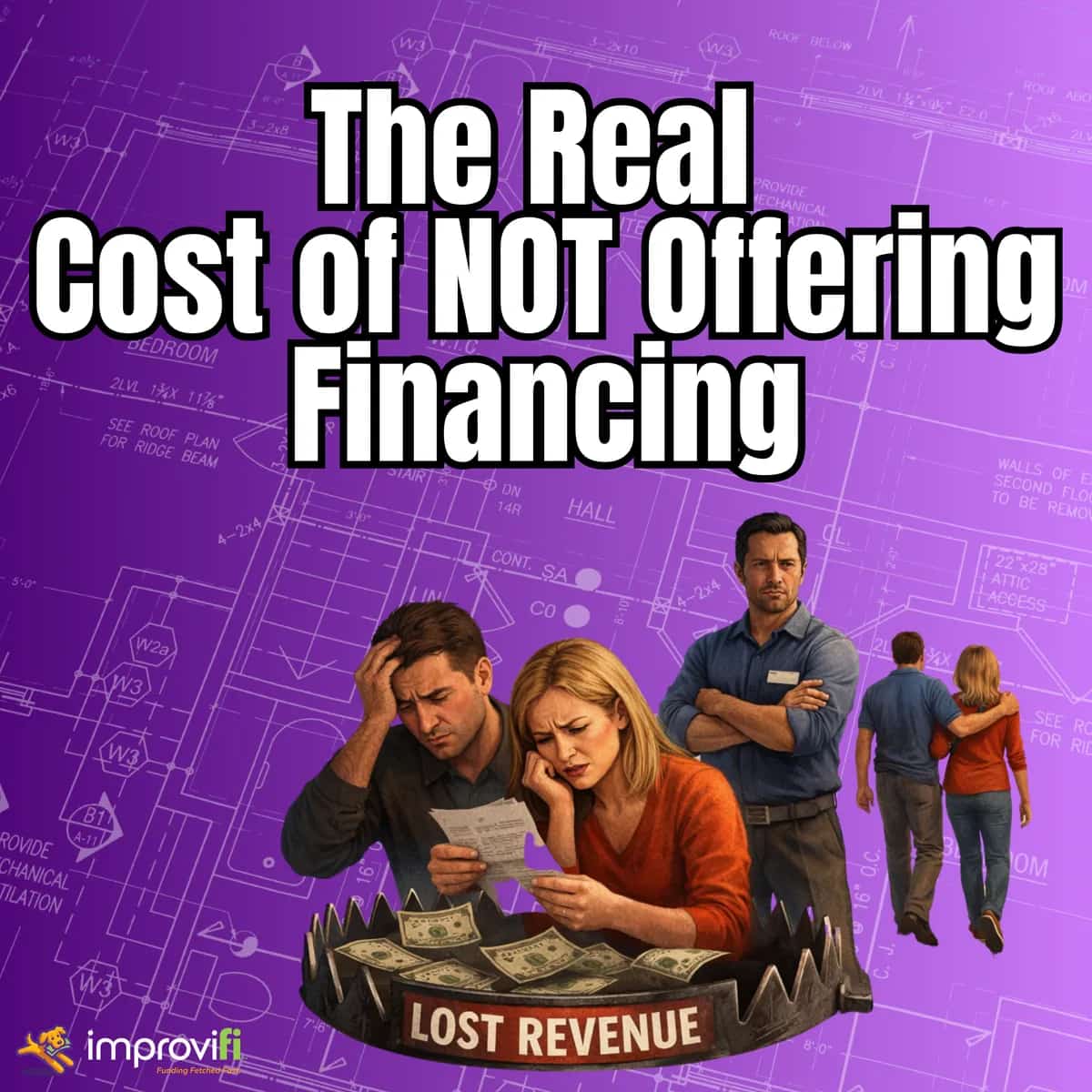

Word-for-Word Scripts and Frameworks for Naturally Bringing Up Financing During Estimates Without Sounding Pushy
Download The Guide Download The Sales ScriptThe Awkward Money Conversation
Picture this moment:
You’ve just spent an hour designing the perfect kitchen with an excited homeowner. You’ve measured, discussed materials, talked about their vision. They’re nodding enthusiastically. Everything is going great.
Then comes the moment you have to talk about money.
Your stomach tightens. You clear your throat. You fumble with your tablet.
Most contractors dread this moment.
And when it comes to bringing up financing? That dread doubles.
The internal dialogue:
- “Will they think I’m pushy?”
- “What if they get offended?”
- “Should I wait for them to ask?”
- “Maybe they don’t need financing…”
- “I don’t want to seem like a used car salesman”
So what happens?
Most contractors either:
- Never mention financing at all
- Awkwardly slip it in at the end: “Uh, we also have financing if you need it”
- Wait for the customer to say “we can’t afford this” before bringing it up
- Present financing as a last resort or sign of desperation
All of these approaches kill sales.
Here’s the truth: The financing conversation doesn’t have to be awkward. It should be natural, helpful, and professional. It’s not pushy—it’s providing options.
This guide will give you:
- Word-for-word scripts that feel natural and authentic
- Frameworks for timing the conversation perfectly
- Responses to every customer reaction
- Body language and delivery tips
- Practice scenarios to build confidence
- Troubleshooting for when things go sideways
By the end, you’ll introduce financing as naturally as you discuss project timelines or material options.
Let’s transform the most uncomfortable part of your sales process into your biggest competitive advantage.
Part 1: The Mindset Shift – You’re Helping, Not Selling
Why Financing Conversations Feel Pushy (And How to Fix It)
The problem: You think financing is something you’re “selling” to customers.
The reality: Financing is a tool you’re offering to help customers achieve their goals.
The difference is everything.
Reframe: From Sales to Service
Instead of thinking: “I need to convince them to finance this project”
Think: “I’m going to show them all their payment options so they can make the best decision”
Instead of thinking: “They might get offended if I mention financing”
Think: “They’ll appreciate knowing they have options beyond paying cash”
Instead of thinking: “Bringing up financing makes me sound desperate for the sale”
Think: “Not mentioning financing is withholding valuable information they need”
The Professional Standard
Imagine going to a car dealership and never being told you could finance the vehicle. You’d think: “That’s weird. Why didn’t they tell me I had options?”
Imagine a furniture store where you had to ask about payment plans. You’d think: “This isn’t very professional. Most stores offer this automatically.”
Home improvement is no different.
Modern, professional contractors offer financing. Customers expect it. Not mentioning it is actually unprofessional.
Your new mindset:
“Offering financing options is part of my professional service. I’m doing customers a disservice by NOT telling them about it. They deserve to know all their options so they can make an informed decision.”
Once you internalize this, the conversation becomes easy.
Part 2: The Five-Stage Framework for Perfect Financing Conversations
The Proven Structure That Works Every Time
Every successful financing conversation follows the same basic structure:
Stage 1: SEED (Plant early) Drop hints about financing before you present the price
Stage 2: PRESENT (Frame in monthly terms) Show the investment in both total cost AND monthly payment
Stage 3: GAUGE (Read their response) Pay attention to verbal and non-verbal cues
Stage 4: GUIDE (Help them choose) Recommend the best payment approach for their situation
Stage 5: APPLY (Make it easy) Facilitate the application process seamlessly
Let’s break down each stage with exact scripts and timing.
Part 3: STAGE 1 – SEED (Plant Early)
Why Early Mentions Matter
The mistake most contractors make: Waiting until after the price presentation to mention financing.
The problem: Now it feels like a rescue attempt. “You look shocked by the price, so here’s financing!”
The better approach: Plant financing seeds throughout the conversation so it’s already in their mind when you present the price.
Early Seeding Scripts
During initial rapport building:
“Before we get started, I should mention we work with several financing partners. A lot of our customers find it helpful to spread payments out rather than paying everything upfront. But let’s focus on designing the perfect project first, and we can talk about payment options later. Sound good?”
Why this works:
- Sets expectation early
- Normalizes financing (“a lot of our customers”)
- Doesn’t force the conversation now
- Removes stigma before price is even mentioned
When discussing project scope:
“We can absolutely do that. Most customers choose to finance features like that since they add significant value but you can enjoy them immediately rather than waiting to save up. Let me show you what this would look like…”
Why this works:
- Associates financing with smart decisions
- Frames it as enjoying benefits now vs. waiting
- Casual, not salesy
When customer mentions budget concerns:
Customer: “We’re trying to stay around $20,000”
You: “Totally understand. Here’s what’s great, we can design to hit that number, or we can show you options above and below. Many customers use financing to upgrade to their dream version for about $200-250 more per month. But let’s nail down exactly what you want first, then we can look at both the total investment and what it breaks down to monthly. Fair?”
Why this works:
- Acknowledges their budget concern
- Introduces monthly framing early
- Gives permission to dream bigger
- Non-committal (“let’s look at both”)
During the design/walkthrough phase:
“This upgraded option is popular, and a lot of customers finance it since the monthly payment difference is only about $45. It’s easier to justify when you think about it that way. Want me to include it in your estimate?”
Why this works:
- Ties specific upgrades to small monthly differences
- Makes “financing” feel normal and common
- Helps them say yes to better options
The Power of Normalization
Notice the pattern in all these early seeds:
- “A lot of our customers…”
- “Many people…”
- “Most customers…”
- “Popular option…”
You’re normalizing financing before they ever need to decide.
By the time you present the price, financing isn’t a foreign concept, it’s something they’ve heard you mention naturally throughout the conversation.
Part 4: STAGE 2 – PRESENT (Frame in Monthly Terms)
The Moment of Truth: Presenting the Investment
This is where most contractors blow it.
The old way: “So the total for this project is $28,000.” [Waits awkwardly for response]
The better way: Present both the total AND the monthly payment simultaneously, framing the monthly payment as the primary number.
The Perfect Price Presentation Script
Script Version 1 (Standard):
“Alright, let me show you what we’re looking at. The total investment for everything we’ve discussed is $28,000.”
“Now, I know that’s a significant number, so let me show you what most of our customers do.”
“If we finance this—which about 65% of our customers choose to do, this breaks down to approximately $311 per month for 10 years at current rates. That’s less than most car payments.”
“Does that monthly amount feel more comfortable than paying the $28,000 all at once?”
Why this works:
- Acknowledges the total is significant
- Immediately provides alternative framing
- Shows this is normal (“65% of our customers”)
- Asks direct question about preference
- Makes monthly number feel reasonable
Script Version 2 (Confident/Assumptive):
“So here’s where we land: This complete kitchen transformation is $28,000, which breaks down to about $311 per month if you finance it. Most of our customers prefer the monthly option since it keeps their savings intact for emergencies and makes this upgrade feel like a subscription rather than a big hit to the bank account.”
“How does $311 a month sound to you?”
Why this works:
- Presents monthly payment immediately with total
- Explains logical reasons to finance
- Assumes they’ll consider financing
- Direct question focuses on monthly, not total
Script Version 3 (For higher-end customers):
“Your total investment is $28,000 for this project. Now, you have two ways to handle this: You can pay the full amount, or you can finance it at about $311 per month and keep your capital working for you in investments. A lot of our clients prefer that second option—they’d rather pay 8% interest on a loan while their money stays invested earning 10-12%. Makes sense from a financial planning perspective.”
“Which approach fits better with how you manage your finances?”
Why this works:
- Respects their financial sophistication
- Positions financing as smart money management
- Appeals to opportunity cost thinking
- Gives them the “smart investor” frame
The Monthly Payment Anchor
Psychological principle: Humans make decisions based on anchors and comparisons.
When you present “$28,000” first, their brain anchors on that large number. Everything else feels big in comparison.
When you present “$311/month” alongside it, their brain can anchor on the smaller, more manageable number.
Comparison technique:
“$311 per month is less than:
- Most car payments ($450 average)
- A family dinner out each week ($350+)
- Premium cable and streaming bundles ($200+)
- Daily Starbucks habits ($180+)
And unlike those things, this investment improves your home value and quality of life every single day.”
This reframes the monthly payment from “expensive” to “reasonable.”
Part 5: STAGE 3 – GAUGE (Read Their Response)
Reading Verbal and Non-Verbal Cues
After you present the price and monthly payment, shut up and watch.
What you’re looking for:
Positive Signals
Verbal:
- “That’s actually pretty reasonable”
- “We can afford that”
- “That’s less than I thought”
- “How does the financing work?”
- “What’s the interest rate?”
Non-verbal:
- Nodding
- Leaning forward
- Looking at spouse with raised eyebrows (positive surprise)
- Relaxing body language
- Reaching for phone/wallet (ready to move forward)
Response: Move directly to Stage 4 (GUIDE) and help them apply.
Book A DemoNeutral Signals
Verbal:
- “Let me think about it”
- “I need to talk to my spouse”
- “Can you email this to me?”
- Silence
Non-verbal:
- Sitting back
- Arms crossed (thinking, not defensive)
- Looking at estimate quietly
- Neutral facial expression
Response: Ask clarifying questions to understand their hesitation.
Your line: “Of course! Before I send this over, I want to make sure I’ve answered everything. When you say ‘think about it,’ is there something specific about the project, the price, or the monthly payment that feels off? I’d love to address it while we’re together.”
Negative Signals
Verbal:
- “That’s way more than we can spend”
- “We can’t afford that”
- “That’s too much”
- “I need to save up”
Non-verbal:
- Physically recoiling
- Grimacing or negative facial expressions
- Looking down or away
- Shifting toward the door
Response: Acknowledge their concern and dig deeper.
Your line: “I hear you. Let me ask—is it the total investment that feels too high, or the monthly payment? Because if it’s the monthly payment, we might be able to adjust the term to bring it down. If it’s the total investment, we can look at phasing the project or scaling back some features. What feels more off—the $28,000 total or the $311 per month?”
The Critical Question: Total or Monthly?
This question is key: “What feels more uncomfortable—the $28,000 total or the $311 per month?”
If they say total: They’re not thinking in monthly terms. Refocus them on monthly payment and help them see it differently.
If they say monthly: The payment is genuinely too high for their budget. Offer options: longer term (lower monthly payment), scaled-down project, or phased approach.
If they say both: The project is out of reach for now. Discuss alternatives: smaller project, DIY portions, or waiting to save up.
Part 6: STAGE 4 – GUIDE (Help Them Choose)
Becoming Their Financing Advisor
Once you know they’re open to financing, your job is to guide them to the right product and terms.
The Product Recommendation Script
For good credit, standard projects:
“Based on what you’ve told me, I’d recommend starting with a personal loan. It’s the fastest option—you’ll get an instant decision today and we could start the project next week. No home equity needed, no appraisal. The rate for someone with good credit like you mentioned is typically around 10-12%, which gets you that $311 monthly payment.”
“Does that sound like a good fit, or would you prefer to explore other options?”
For customers with equity and flexibility:
“You mentioned you have quite a bit of equity in your home and timeline isn’t urgent. In that case, a home equity loan might save you money. The rate would be about 3-4 points lower—maybe 7% instead of 11%—which could drop your payment to around $265 per month. The tradeoff is it takes 4-6 weeks to close.”
“Is the lower payment worth the wait, or would you rather move faster with a personal loan?”
For rate-sensitive customers:
“Since you mentioned wanting to avoid interest if possible, we have promotional financing—0% for 18 months if you can pay it off in that timeframe. That means if you can swing about $1,550 per month for 18 months, you’d pay zero interest. But if any balance remains after 18 months, all the interest gets charged retroactively.”
“Can you realistically pay $1,550 a month, or would you prefer a traditional loan with a lower monthly payment?”
The Three-Option Close
When customers seem unsure, present three options:
“Let me give you three ways to handle this:
Option 1 – Personal Loan: $311/month for 10 years, instant approval, start next week. Total cost with interest: about $37,300.
Option 2 – Home Equity Loan: $265/month for 10 years, 4-6 week approval, save about $5,500 in interest. Total cost: about $31,800.
Option 3 – Promotional Financing: $1,555/month for 18 months, zero interest if paid off on time. Total cost: $28,000 (same as cash if paid off).
Most customers in your situation choose Option 1—it’s the perfect balance of speed and affordability. But which one speaks to you?”
Why this works:
- Gives clear choices with pros/cons
- Anchors them on “most customers choose…”
- Asks them to choose, not “yes or no”
- All roads lead to a sale
Part 7: STAGE 5 – APPLY (Make It Easy)
Removing Friction from the Application Process
You’ve successfully introduced financing. They’re interested. Now make it ridiculously easy to apply.
The Seamless Application Script
Script Version 1 (On-site application):
“Perfect! The application is super simple—takes about 3 minutes on your phone. I can text you the link right now, and while you’re filling it out, I’ll grab some water for us. We’ll usually get an instant decision, and then we can move right to signing the contract if you’re approved. Sound good?”
“I’ll give you some privacy. Just give me a shout when you’re done or if you have any questions.”
Why this works:
- Sets clear expectations (3 minutes, instant decision)
- Gives them privacy
- Removes pressure
- Natural transition to next step
Script Version 2 (Email/text for later):
“Awesome. What I’ll do is text you the application link along with this estimate. The app takes about 3 minutes to complete, and you’ll get a decision usually within minutes—sometimes instantly. Once you’re approved, just text me back and we’ll get everything signed and scheduled. And if you have any questions while you’re filling it out, I’m a phone call away.”
Why this works:
- Puts ball in their court without pressure
- Sets expectations for timeline
- Offers support
- Keeps momentum going
Script Version 3 (Multiple household members):
“Since you mentioned wanting to include your spouse in this decision, here’s what I recommend: I’ll send you both the estimate and the financing application link. You two can review everything together tonight, and one of you can complete the application. Most couples have the higher credit score person apply. Once you’re approved, we’ll all connect and finalize everything. How does that sound?”
Why this works:
- Respects their decision-making process
- Gives clear next steps
- Keeps door open without being pushy
Handling the Application Moment
If customer seems hesitant to apply:
“I totally get it—filling out financial applications can feel like a big step. Here’s what makes this one easy: There’s no obligation to accept if you’re approved. You’re just seeing what you qualify for. Think of it like getting pre-approved for a mortgage—it tells you what’s possible, but you don’t have to move forward. Would you like to see what you qualify for?”
If customer worries about credit impact:
“Great question. The initial soft credit check doesn’t affect your score at all—it’s just a pre-qualification. Only if you accept the loan and sign does it become a hard inquiry, and even then it’s usually just a 5-10 point temporary dip. And as you make on-time payments, your score actually improves. So the short-term impact is minimal, and long-term it’s actually positive.”
If customer wants to think about it:
“Absolutely! Here’s what I’d suggest though: Let’s at least get you pre-approved so you know what you qualify for. That way you’re making a decision with complete information rather than guessing. The approval is good for 30 days with no obligation. If you decide not to move forward, no harm done. But at least you’ll know your options. Make sense?”
Part 8: Handling Common Customer Responses
What to Say When They Say…
“We’ll just pay cash”
Response:
“That’s fantastic that you have that option! Can I share what a lot of our cash-capable customers end up doing? They choose to finance anyway because they’d rather keep that $28,000 in their savings or investments and pay a small interest rate, rather than depleting their emergency fund. That way if something unexpected happens—car breaks down, medical expense, job change—they still have their reserves. Plus, if your money is invested and earning 10-12%, it doesn’t make sense to pull it out to avoid paying 8% interest. Does that perspective make sense?”
Alternative response (shorter):
“Love it! Just so you know, you can always pay cash—but most of our customers who can pay cash still choose to finance to keep their savings intact. Either way works. Which feels better to you?”
“What’s the interest rate?”
Response:
“Great question. The rate is credit-dependent, but with good credit you’re typically looking at 9-13% for a personal loan, or 6-8% for a home equity loan if you go that route. I know those numbers sound higher than mortgage rates, but remember mortgages are secured by your home—these are different products. The good news is we can get you an actual rate quote in about 3 minutes. Want to see what you qualify for specifically?”
Advanced response (reframe rate concern):
“The rate will depend on your credit, but here’s how I encourage customers to think about it: The question isn’t ‘is 11% expensive,’ it’s ‘is this kitchen worth $311 per month for 10 years?’ If you got zero percent financing, your payment would be $233 per month. So you’re basically asking yourself: Is this kitchen worth an extra $78 per month? For most people, the answer is yes—they’d rather have the kitchen now for a few extra dollars a month than wait 3 years to save up. Make sense?”
“That’s way too expensive”
Response:
“I hear you. Let me ask—is it the $28,000 total that feels too high, or the $311 monthly payment? Because we have some options depending on which one is the issue.”
If they say total is too high:
“Got it. A couple options: We can scale back some features to bring the total down, or we can do this in phases—maybe we do the cabinets and countertops now ($18,000), then circle back in 6-8 months for the flooring and backsplash ($10,000). That way you get the transformation started without the full investment up front. Which sounds better?”
If they say monthly is too high:
“Understood. We can extend the term to bring that monthly payment down. Instead of 10 years, we could do 12 years—that drops your payment to around $270. Or 15 years gets you down to around $240 per month. Lower payment, longer term. Does one of those work better for your budget?”
“We need to think about it”
Response:
“Totally fair! Before you go, though, I want to make sure I’ve answered all your questions. When you say ‘think about it,’ is there something specific you’re unsure about—the project scope, the price, the monthly payment, or something else? I’d love to address it now while we’re together rather than you having to call back later.”
Follow-up based on their answer:
If they have a specific concern → Address it directly If they say “just need time” → Set specific follow-up
“I get it. How about this—let me send you the estimate and the financing application link tonight. Take a day or two to review everything, talk it over, and maybe even get pre-approved so you know exactly what you qualify for. Then let’s reconnect Friday morning and answer any questions. Does 10am Friday work for a quick call?”
“I need to talk to my spouse”
Response:
“Absolutely! That’s an important decision to make together. Here’s what I’ll do: I’ll send you both the complete estimate along with the financing application link. What most couples do is review everything together tonight, then one of you completes the quick application. You’ll know within minutes what you’re approved for, and then we can all connect tomorrow or the next day to finalize everything. When would be good for all three of us to chat—tomorrow evening?”
“What if we get declined?”
Response:
“Good question. First, the approval rate is actually pretty high—most of our customers get approved by at least one lender. But if for some reason you don’t qualify, we have a couple options: We can try alternative lenders with different criteria, we can work out a direct payment plan with us, or we can scale the project down to something that works cash. Either way, we’re not going to just leave you hanging. We’ll find a way to make this work. Sound fair?”
Part 9: Body Language and Delivery Tips
It’s Not Just What You Say, It’s How You Say It
Your Energy Matters:
❌ Wrong energy: Apologetic, tentative, nervous
- “Um, we also have financing if you, like, need it or whatever…”
- Signals: You don’t believe in it, or you think they should be embarrassed
✓ Right energy: Confident, helpful, matter-of-fact
- “Let me show you the payment options most of our customers use…”
- Signals: This is normal, professional, and helpful
Body Language Dos and Don’ts
DO: ✓ Maintain eye contact when mentioning financing ✓ Use open hand gestures (shows transparency) ✓ Lean slightly forward (shows engagement) ✓ Smile naturally (this is good news, not bad news) ✓ Have materials ready (tablet, rate sheets) to show preparation
DON’T: ✗ Look down or away when mentioning financing ✗ Cross your arms (defensive) ✗ Speak quieter or faster (shows discomfort) ✗ Fumble with papers (shows lack of preparation) ✗ Apologize for mentioning financing
Voice and Tone
When presenting the price:
- Pace: Steady, not rushed
- Volume: Normal, confident
- Tone: Matter-of-fact, not apologetic
When presenting the monthly payment:
- Pace: Slightly slower (let them process each number)
- Volume: Clear and confident
- Tone: Helpful, almost excited
Practice this: Record yourself saying: “The total investment is $28,000, which breaks down to about $311 per month with financing.”
Listen back. Do you sound:
- Confident and helpful? (Good!)
- Apologetic or uncertain? (Practice more!)
The Power of the Pause
After presenting financing, PAUSE.
Count to 3 in your head. Let them process. Let silence do the work.
Weak contractors: Fill the silence immediately with more talking Strong contractors: Present the option, then shut up and wait
The first person to speak after the pause often reveals the objection you need to address.
Part 10: The Complete Conversation Flow (Start to Finish)
Putting It All Together – Full Script Example
SCENE: Kitchen remodel estimate, customer’s home
[Early in conversation – SEEDING]
You: “Before we dive in, I should mention we work with several financing partners. Most of our customers choose to finance their projects since it makes the investment more manageable. But let’s focus on designing your dream kitchen first, and we’ll talk about payment options at the end. Sound good?”
Customer: “Sounds good.”
[During design phase – NORMALIZING]
Customer: “I love those upgraded cabinets, but are they a lot more expensive?”
You: “They’re about $4,200 more than the standard. But here’s how I’d think about it: That’s about $47 more per month if you finance. For cabinets you’ll use every single day for the next 20 years, most customers say it’s worth the extra $47 a month. Want me to include them in the estimate?”
Customer: “Yeah, let’s include them.”
[Presenting the price – STAGE 2]
You: “Alright, let me show you where we landed. The total investment for this complete kitchen transformation—cabinets, countertops, backsplash, new flooring, the upgraded appliances, everything—is $32,500.”
“Now I know that’s a significant number, so let me show you what most of our customers do.”
“If we finance this, which about 65% of our customers choose to, this breaks down to approximately $361 per month for 10 years. That’s actually less than the average car payment.”
“How does that monthly amount feel to you?”
[Customer responds – STAGE 3 GAUGING]
Customer: “Hmm. That’s more than we were thinking. We wanted to stay around $25,000.”
[Acknowledge and guide – STAGE 4]
You: “Totally understand. Let me ask, is it the $32,500 total that feels too high, or the $361 monthly payment?”
Customer: “Both, honestly. We were thinking more like $25,000 total.”
You: “Got it. So we have a couple options here. We can scale back to hit that $25,000 number—maybe go with the standard cabinets instead of upgraded, or save the flooring for a phase two down the road. That would get you to about $278 per month.”
“Or, if you really want everything we’ve designed here, we could extend the financing term to 12 years instead of 10. That brings your monthly payment to about $315—about $46 less per month. You’d pay a bit more interest over time, but you get everything you want now.”
“Which direction feels better—scaling back the project to $25,000, or keeping everything at $32,500 but extending to 12 years?”
[Customer decides]
Customer: “I think we want to keep everything. The $315 a month for 12 years is doable.”
[Move to application – STAGE 5]
You: “Perfect! I love that you’re going with the dream version. The application is super simple—takes about 3 minutes on your phone. I can text you the link right now, and we’ll typically get an instant decision. Then if you’re approved, we’ll sign the contract and get you on the schedule. Sound good?”
Customer: “Yeah, let’s do it.”
You: “Great. What’s the best number to text?”
“I’ll give you guys a few minutes of privacy to fill that out. I’ll be out in my truck grabbing some samples for another project. Just text me when you’re done or if you have any questions.”
[15 minutes later – approved]
Customer: [Texts] “We got approved!”
You: [Returns inside] “Congrats! Let me show you what you qualified for…”
SCENE END
What Made This Work?
✓ Seeded financing early ✓ Normalized it throughout conversation ✓ Presented monthly payment with confidence ✓ Acknowledged their concern without retreating ✓ Offered solutions, not just problems ✓ Made application process easy and pressure-free ✓ Closed the deal
Book A DemoPart 11: Industry-Specific Scripts
Tailored Approaches for Different Trades
ROOFING
Early seed: “Most homeowners don’t have $15,000 sitting around for a roof, which is why about 70% of our customers finance. Especially for emergency situations like this—you need the roof fixed before winter, not after you spend 2 years saving up.”
Price presentation: “Total investment for this roof system is $18,500, which breaks down to about $206 per month for 10 years. Think of it like an insurance payment—except instead of paying insurance on an old, leaky roof, you’re paying for a brand new roof that protects your most valuable asset. Makes sense, right?”
KITCHEN & BATH
Early seed: “Since kitchens and bathrooms are the heart of the home, most of our customers choose to finance them. That way they get to enjoy the transformation immediately rather than waiting years to save up. Plus, these upgrades add significant value to your home.”
Price presentation: “This complete kitchen transformation is $35,000, or about $389 per month financed. Now I know that sounds like a lot, but think about it this way: You’ll use this kitchen 3-5 times a day, every single day, for the next 15-20 years. That’s about 65 cents per day over the life of the loan. Worth it?”
HVAC
Early seed: “Good news is we have several financing options, including 0% for 18 months on new systems. A lot of our customers take advantage of that, especially when their system dies unexpectedly and they need immediate replacement.”
Price presentation: “New system installed is $8,500, or with the 0% promotion, that’s $472 per month for 18 months if you pay it off on time. That’s the same as cash, just spread out. And honestly, when it’s 95 degrees outside, most people would rather pay $472/month than wait to save up $8,500. Wouldn’t you?”
WINDOWS & SIDING
Early seed: “These upgrades pay for themselves in energy savings over time, which is why financing makes so much sense. You’re essentially using your future energy savings to pay for the improvements. Many of our customers look at it that way.”
Price presentation: “Total investment for all your windows is $22,000, which is about $245 per month financed. Now factor in that you’ll probably save $80-120 per month in energy costs. So your net out-of-pocket is really only $125-165 per month. And at the end of 10 years, the loan is paid off but the energy savings continue forever. It’s actually a pretty smart investment.”
DECKS & OUTDOOR LIVING
Early seed: “Summer’s coming and nobody wants to wait 2-3 years to save up for their dream deck. That’s why most of our customers finance—they get to enjoy their outdoor space all summer instead of waiting.”
Price presentation: “This complete outdoor living space is $28,000, or about $311 per month financed. Think about how many BBQs, family gatherings, and summer evenings you’ll enjoy out here. If you host just two events per month, that’s like spending $5 per person per event over the life of the loan. Totally worth it, right?”
BASEMENT FINISHING
Early seed: “Finishing a basement is one of those projects that makes so much sense to finance because you’re essentially adding a whole new floor to your house for a fraction of what an addition would cost. Most of our customers finance it and think of the payment as ‘rent’ they’re paying themselves.”
Price presentation: “Complete basement finish with the bar, bathroom, and media area is $45,000, or about $500 per month financed. Now if you were renting that space from a landlord, you’d pay $1,200-1,500 per month easily. So you’re essentially paying yourself $500/month to own 1,000 square feet of finished space. Best investment you can make.”
Part 12: Overcoming Your Own Mental Barriers
The Internal Scripts That Hold You Back
Your confidence in presenting financing is the #1 factor in customer acceptance.
If YOU believe financing is helpful and normal, customers will too. If YOU feel awkward about it, customers will feel awkward.
Common Mental Barriers and How to Overcome Them
Barrier #1: “I feel like a pushy salesman”
Reframe: You’re a solutions provider. Doctors don’t feel pushy when they prescribe medication. Financial advisors don’t feel pushy when they recommend investment strategies. You’re simply presenting options that help customers achieve their goals.
Exercise: List 5 customers who would have benefited from knowing about financing but you never told them. Feel that regret? That’s what happens when you withhold helpful information.
Barrier #2: “What if they get offended?”
Reality check: In 10 years of contractors offering financing, I’ve never heard of a customer getting offended that options were presented. At worst, they say “no thanks.” At best, you make a sale you would have lost.
Reframe: Would a customer be offended if you said “We accept credit cards”? Of course not. Financing is the same—it’s just a payment method.
Barrier #3: “I’m not good at explaining financial stuff”
Solution: You don’t need to be a financial expert. You need to know 5 key things:
- Total project cost
- Approximate monthly payment
- How to send an application link
- Which lenders work best for which customers
- How to say “the lender handles all the details”
Practice script: “I’m not a financial expert, but here’s what I know: This project is $X, which breaks down to about $Y per month. The application takes 3 minutes, and you’ll get an instant decision. The lender handles all the terms and details. Want to see what you qualify for?”
That’s it. That’s all you need.
Barrier #4: “My market/customers are different”
Reality check: Every contractor thinks their market is unique. “My customers are blue-collar and prefer cash.” “My customers are wealthy and don’t need financing.” “My area is too rural/urban/conservative/expensive.”
Data says otherwise:
- 60-70% of customers choose financing when offered, regardless of market
- This holds true in Manhattan and in rural Montana
- It holds true for $5,000 projects and $100,000 projects
- It holds true for wealthy customers and working-class customers
Your customers aren’t different. They’re human. And humans prefer manageable monthly payments over large lump sums.
Barrier #5: “I don’t want to deal with declined applications”
Reality: Yes, some customers will get declined. That’s life. But here’s what you’re missing:
Without financing:
- Customer can’t afford $28,000
- You don’t get the sale
- Decline rate: 100%
With financing:
- Customer can’t afford $28,000 cash
- They apply for financing
- 60% get approved → You get the sale
- 40% get declined → You’re back where you started (no sale)
You literally have nothing to lose and everything to gain.
Even if half your applications get declined, you’re still closing WAY more deals than you would without offering financing.
Part 13: Role-Play Scenarios for Practice
Build Confidence Through Repetition
The only way to get comfortable with financing conversations is to practice them.
Grab a colleague, team member, spouse, or friend. Run through these scenarios until they feel natural.
Scenario 1: The Enthusiastic Customer
Setup: Customer loves the design. No hesitation about project scope. You present the price.
You: “So the total investment for everything we’ve discussed is $24,000, which breaks down to about $267 per month with financing. How does that monthly amount sound?”
Customer (Role-play partner): “Oh wow, that’s actually really reasonable! How does the financing work?”
You: [Explain application process and move to Stage 5]
Scenario 2: The Budget-Conscious Customer
Setup: Customer mentioned multiple times they’re on a tight budget.
You: “I know budget is important to you. The total for this project is $18,000, which we can finance at about $200 per month. Does that monthly number fit your budget?”
Customer: “Hmm, that’s still a bit more than we wanted to spend monthly. We were thinking more like $150.”
You: “Got it. We have two options: We can extend the term to bring your payment down to about $165 per month—that’s the closest we can get to $150 while keeping the full project. Or we can scale back some features to hit the $150 target. Which would you prefer?”
Scenario 3: The Cash-Preferring Customer
You: “Total investment is $22,000, or about $245 per month financed. How would you like to handle payment?”
Customer: “We’ll just pay cash.”
You: “That’s great that you have that option! Can I ask—would you be open to at least hearing why a lot of our cash-capable customers still choose to finance? It’s a perspective you might not have considered.”
Customer: “Sure, why not?”
You: [Present cash vs financing reasoning from Part 8]
Scenario 4: The Rate-Sensitive Customer
You: “…which breaks down to about $311 per month financed.”
Customer: “What’s the interest rate?”
You: “With good credit, typically 10-12% for a personal loan. I know that sounds higher than mortgage rates, but the real question is: Is this kitchen worth $311 per month? If we got you zero percent, your payment would be $233. So you’re asking yourself if it’s worth an extra $78 per month to have this kitchen now versus waiting 3 years to save up. For most people, the answer is yes. What do you think?”
Scenario 5: The Spousal Consultation Needed
You: “…about $356 per month with financing. How does that sound?”
Customer: “I need to talk to my wife before we move forward.”
You: “Absolutely! Here’s what I’ll do: I’ll send you both the estimate and the financing application link. You two can review everything together tonight, and then one of you can complete the quick 3-minute application to see what you qualify for. When’s a good time tomorrow for us to reconnect and finalize everything?”
Practice each scenario 3-5 times until:
- You can deliver scripts without reading
- You sound natural and confident
- You can adapt to different customer responses
- You feel comfortable, not nervous
Part 14: The First 10 Conversations (What to Expect)
Building Real-World Confidence
Here’s what will happen as you start implementing these scripts:
Conversations 1-3: Awkward and Uncomfortable
- You’ll stumble over words
- You’ll forget parts of the script
- You’ll feel unnatural
- Some customers will sense your discomfort
This is normal. Keep going.
Conversations 4-6: Getting Better
- Scripts start to feel more natural
- You remember key phrases without thinking
- Customer responses start to feel predictable
- You close your first financed deal
Confidence is building. Keep practicing.
Conversations 7-10: Breakthrough Moments
- You stop thinking about the script—it just flows
- You adapt naturally to different customer responses
- Customers respond positively to your confidence
- Financing becomes a normal part of your process
You’ve turned the corner. You’re now comfortable.
After 10 conversations:
- Offering financing feels as natural as discussing materials
- You’re no longer nervous about the conversation
- Your close rate has noticeably improved
- You wonder why you ever hesitated
The confidence breakthrough happens around conversation #7-8 for most contractors.
You just have to get there.
Part 15: Troubleshooting Common Mistakes
What to Do When It Goes Wrong
Mistake #1: Waiting Too Long to Mention Financing
What happens: You present the price. Customer looks shocked. You panic and say “Oh, we also have financing!”
Why it fails: It looks like a desperate rescue attempt.
Fix: Seed financing earlier in the conversation. Normalize it before price presentation.
Mistake #2: Apologizing for Financing
What happens: “Sorry, the price is high, but we do have financing if you need it…”
Why it fails: You’ve signaled that financing is for people who can’t afford things. Embarrassing.
Fix: Present financing confidently as a smart option, not a desperation move.
Mistake #3: Presenting Only the Total Price
What happens: “The project is $28,000.” [Silence. Awkwardness.]
Why it fails: You’ve anchored them on the big scary number with no alternative.
Fix: Always present monthly payment alongside total price.
Mistake #4: Talking Too Much After Presenting
What happens: You present financing, then immediately fill the silence with more talking.
Why it fails: You don’t give them time to process. You sound nervous.
Fix: Present financing. Pause. Count to 3. Wait for their response.
Mistake #5: Not Having a Device/Materials Ready
What happens: “Oh, uh, financing? Yeah we have that. Let me, uh, find the info…”
Why it fails: You look unprepared and unprofessional.
Fix: Have tablet/phone ready. Know your scripts. Be prepared.
Mistake #6: Giving Up After First Objection
What happens: Customer: “That’s expensive.” You: “Okay, well think about it and let me know.”
Why it fails: You didn’t address the objection or offer solutions.
Fix: Use scripts from Part 8 to handle objections and guide them to solutions.
Mistake #7: Not Following Up After Application Sent
What happens: You send the application link, then wait passively for them to apply.
Why it fails: People get busy. Without follow-up, applications don’t get completed.
Fix:
- Day 1: Send application link
- Day 2: Text: “Hey! Did you get a chance to complete that quick application? Let me know if you have any questions!”
- Day 3: Call: “Just wanted to check in on your application. Any questions I can answer?”
Part 16: Advanced Techniques for Masters
Taking Your Financing Conversations to the Next Level
Once you’ve mastered the basics, these advanced techniques will make you unstoppable.
Technique #1: The Pre-Qualification Question
Before even starting the estimate:
“Before we dive into the design, let me ask: If this project comes in at $25,000-30,000, is that something you’re prepared to invest in right now, or would you be looking at financing options?”
Why this is powerful:
- Qualifies budget early
- Gets them thinking about financing before you present
- Eliminates surprise/sticker shock later
- Helps you gauge which loan products to recommend
Technique #2: The Upgrade Sandwich
When presenting Good/Better/Best options:
“So we have three levels:
Good package: $18,000 or $200/month – Gets you everything you need Better package: $25,000 or $278/month – Adds [specific upgrades] for $78 more per month Best package: $32,000 or $356/month – Premium everything, adds another $78/month
Most of our customers land on the Better package—it’s the sweet spot. Which one speaks to you?”
Why this works:
- Frames upgrades in monthly payment differences (small numbers)
- Anchors them on “Better” as the norm
- Makes upgrade decision feel easy
Technique #3: The Competitor Reference
When you know competitors offer financing:
“I’m sure as you’re getting estimates, you’ll hear about financing options from other contractors too. What I’ll tell you is this: We work with multiple lenders to give you the best options, and we’ll help you through the entire process. Some contractors just hand you a phone number and say ‘call them.’ We actually partner with you to make sure you get approved and funded. That difference matters.”
Why this works:
- Acknowledges competitive reality
- Positions your service as superior
- Builds trust through transparency
Technique #4: The Savings Offset
For energy-efficient upgrades:
“These windows are $22,000, or $245/month financed. But here’s the thing: You’ll save about $90-110 per month on energy bills. So your net out-of-pocket is really only $135-155 per month. And in 10 years when the loan is paid off, that $100/month savings continues forever. You’re not spending $245—you’re investing $245 to save $100, so it only costs you $145. Make sense?”
Why this works:
- Reframes cost as investment
- Shows actual net cost is lower
- Demonstrates long-term value
Technique #5: The Refinance Option
For customers concerned about rates:
“I hear you on the rate. Here’s what some of our customers do: They take the financing now to get the project done, then in 12-18 months when their credit has improved or rates have dropped, they refinance to a lower rate. That way they get to enjoy the improvement now rather than waiting, and they can still optimize the rate later. Gives you the best of both worlds.”
Why this works:
- Acknowledges rate concern
- Provides solution
- Removes barrier to moving forward now
Part 17: Team Training Blueprint
Teaching Your Team to Have Perfect Financing Conversations
If you have a sales team, they need to master these conversations too.
Week 1: Knowledge Building
Day 1: Overview Training (2 hours)
- Why we offer financing (business benefits)
- How financing works (customer perspective)
- Our lender partners and products
- Expected outcomes (approval rates, close rates)
Day 2: Script Training (2 hours)
- Review all scripts from this guide
- Practice delivery
- Record and review
Day 3: Objection Handling (1 hour)
- Common objections and responses
- Role-play practice
- Build confidence
Week 2: Role-Play Practice
Day 1-3: Peer Practice (30 min daily)
- Pair up team members
- Run through scenarios from Part 13
- Give each other feedback
Day 4: Group Role-Play (2 hours)
- Each person presents to the group
- Group provides constructive feedback
- Build collective confidence
Day 5: Manager Role-Play (1 hour)
- Each person presents to you
- You play difficult customer
- Test their readiness
Week 3: Real-World Implementation
Day 1-5: Live Estimates with Support
- Team members present financing on real estimates
- You shadow or debrief after
- Provide coaching and encouragement
Week 4: Review and Refine
Group meeting (1 hour):
- What worked? What didn’t?
- Share successes and challenges
- Refine scripts based on real experience
- Celebrate first financed sales
Ongoing Development
Monthly check-ins:
- Review financing metrics (applications, approvals, closes)
- Share best practices
- Address new objections or challenges
- Continue building confidence
Quarterly training refreshers:
- Review scripts
- Practice challenging scenarios
- Update team on new lenders or programs
- Recognize top performers
Part 18: Measuring Your Success
Key Metrics to Track
Track these numbers weekly:
Input Metrics:
- Estimates provided
- Financing mentioned (should be 100%)
- Applications submitted
- Application rate (applications ÷ estimates)
Goal: 60-80% application rate
Output Metrics:
- Applications approved
- Approval rate (approvals ÷ applications)
- Approved applications that sign contract
- Conversion rate (signed contracts ÷ approvals)
Goal: 70-85% conversion rate
Results Metrics:
- Revenue from financed projects
- Average financed project value
- Close rate on all estimates (should increase 15-25 points)
- Overall revenue growth
Goal: 50-75% revenue growth in first year
The Improvement Loop
Every week, ask:
- What went well? (Celebrate successes)
- What challenges came up? (Identify problems)
- What can we improve? (Implement solutions)
- What will we do differently next week? (Commit to change)
Continuous improvement makes good scripts great and great scripts unstoppable.
Part 19: The Confidence Building Plan
30 Days to Mastery
Week 1: Preparation
- Day 1-2: Read this guide completely
- Day 3-4: Write out your personal scripts
- Day 5-6: Practice alone (record yourself)
- Day 7: Role-play with team member
Week 2: Implementation
- Day 8-14: Mention financing on every estimate
- Goal: 5 financing conversations minimum
- Don’t worry about results, focus on delivery
Week 3: Refinement
- Day 15-21: Adjust scripts based on real reactions
- Focus on smooth delivery
- Goal: Submit 3-5 applications
Week 4: Mastery
- Day 22-30: Financing conversations feel natural
- Goal: Close 2-3 financed deals
- Celebrate success
By day 30, you’ll be confident, comfortable, and closing more deals than ever.
Part 20: Your First Financing Conversation
Starting Today
You’ve read the guide. You know the scripts. You understand the framework.
Now comes the most important part: Actually doing it.
Your assignment for this week:
✅ Pick 3 scripts that feel most natural to you
✅ Practice them 5 times each out loud
✅ Mention financing on your next 5 estimates
✅ Submit at least 1 application
That’s it. Just start.
The first conversation will be awkward. That’s okay. The second will be better. By the fifth, you’ll feel comfortable. By the tenth, you’ll be a pro.
But you have to start with conversation #1.
The Conversation That Changes Everything
The financing conversation is the difference between:
- 28% close rate and 47% close rate
- $15,000 average projects and $24,000 average projects
- $400,000 annual revenue and $700,000 annual revenue
- Struggling business and thriving business
It’s one conversation. But it changes everything.
The scripts are in your hands. The framework is clear. The objections are addressed.
The only question is: Will you have the conversation?
Every estimate without financing mentioned is money left on the table. Every “think about it” response is a missed opportunity. Every scaled-down project is a disappointment you could have prevented.
The conversation isn’t pushy. It’s helpful. The conversation isn’t awkward. It’s professional. The conversation isn’t hard. It’s just practice.
Start today. Master it this month. Transform your business this year.
The perfect financing conversation isn’t perfect because of perfect words.
It’s perfect because you had it.
🎯 Ready to Start Your 30-Day Journey?
Begin Your Application Today
📋Start Your Marketplace Application Complete the Improvifi marketplace application to get matched with the perfect lending partners for your business.
🔗 Book Your Call with Improvifi →
📚 Continue Your Learning Journey
Next Recommended Guide: “How to Become a Financing-Enabled Contractor in 30 Days” Your step-by-step roadmap from application to your first financed sale.
Questions? We’re Here to Help
💬 Email: support@improvifi.com 🌐 Website: www.improvifi.com
About Improvifi
Improvifi specializes in helping contractors integrate home improvement financing into their business models. We partner with you to select the right contractor financing programs, train your team, and provide ongoing support to maximize your financing success.
Our mission: Help contractors win more jobs, grow their revenue, and use Improvifi as their new competitive edge
This guide is part of the Improvifi Learning Center. For complete access to all 20 guides, video tutorials, and exclusive tools, visit improvifi.com/learning-center
🎥 Connect With Us on YouTube
Want to see how it works in real time?
👉 Check out our YouTube channel: Improvifi on YouTube
You’ll find quick training clips, contractor success stories, and walkthroughs showing exactly how our multi-lender home improvement financing platform helps you close more jobs, faster.
Subscribe for weekly videos on:
- Sales & financing best practices
- Real contractor case studies
- Financing script examples
- Objection handling and payment framing
Your next growth breakthrough might start with a 3-minute video.
Book A Demo